
Make a nine patch block any size
The nine patch is a popular traditional quilt block because it is easy to make and versatile to use. Once you know the basic construction technique, you can make this block any size you want.
Nine Patch is the name given to a block that is made up of nine pieces – three across and three down. Usually they are alternating light and dark pieces of equal size.

These tips will help you design your own nine patch blocks. See how to make a basic nine patch block.
Below you will find
- video
- tips with diagrams
- nine patch block variations
- quilts with nine patch blocks
Tips for sizing the block
A nine patch block can be made any size, but some sizes are easier than others.
If you want a size divisible by three
To design your own block, you just need to take the finished size that you want and divide that by three. That will give you the size of the small squares that you need.
This is really simple if you want blocks that are 6″, 9″, or even 15″ – those numbers all divide nice and evenly by 3.
Example – 15″ block
If a block will finish at 15″, then we divide by 3 to get 5.
That means we will cut the pieces 5-1/2″.
When they are put together, the block will be 15-1/2″ because it has seam allowances.
If you want a size not divisible by three
But what if you want an 8″ block? Sure, you can divide by 3, but then you end up with math like 2-2/3″. Then you will have to add 1/2″ to include the seam allowances.
If you want to bother with the math, you will get 3-1/6, but no quilting rulers come with 1/6″ lines.
I have a trick I use to do this. It is what I used in the double nine patch block. Instead of dividing evenly by three, split the size into three close numbers.
8″ block option 1
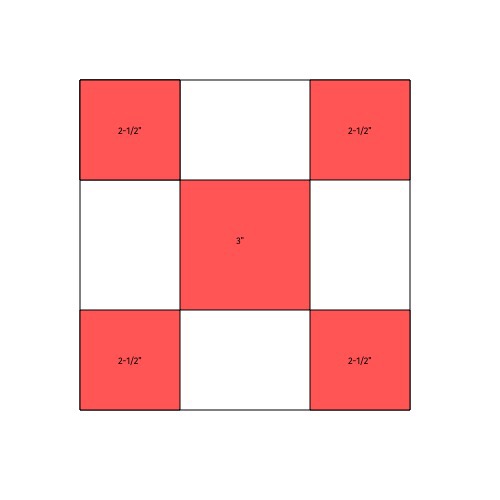
Eight is 5 + 3, so it is also 2-1/2 + 2-1/2 + 3. You can make a block with 2-1/2″ squares on the corners and a 3″ square in the centre. The side pieces will be 2-1/2″x3″ rectangles.
8″ block option 2
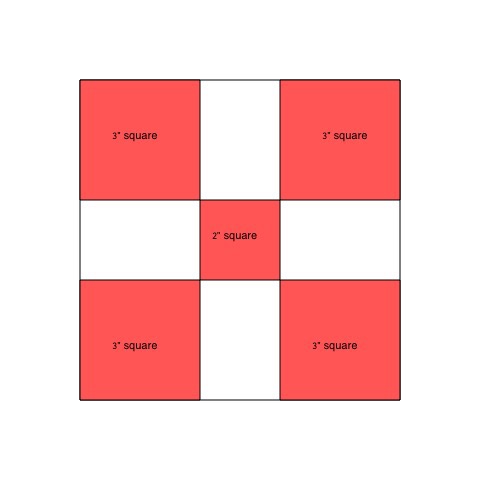
Another option is made by using another arithmetic fact. Eight is 6 + 2, so it is 3 + 3 + 2. You could make a block with a 2″ square in the centre and 3″ squares on the corners.
8″ block option 3
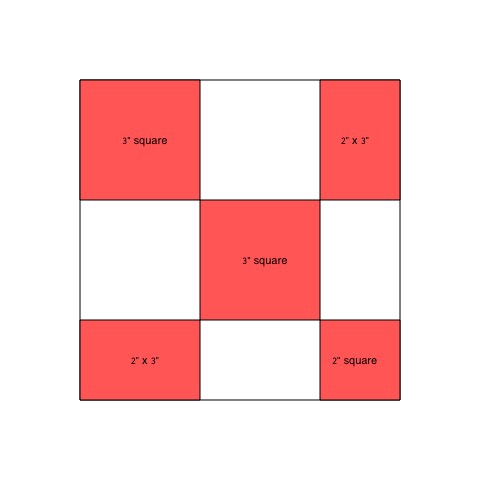
I usually put the odd measurement in the centre so that all the pieces are squares, but there is no reason that you have to. You could have the centre and one corner at 3″ and one corner at 2″. That makes the other two corners 2″x3″.
You can divide up the block any way you want, just remember that if it is not divided evenly, some of your pieces will now be rectangles and not squares.
If you’re stuck
If you are struggling with figuring out the math, go old school and sketch the block on graph paper. This will make it easy to see what shapes you need.
Just remember to add 1/2″ to each piece for seam allowances!
Blocks that aren’t square
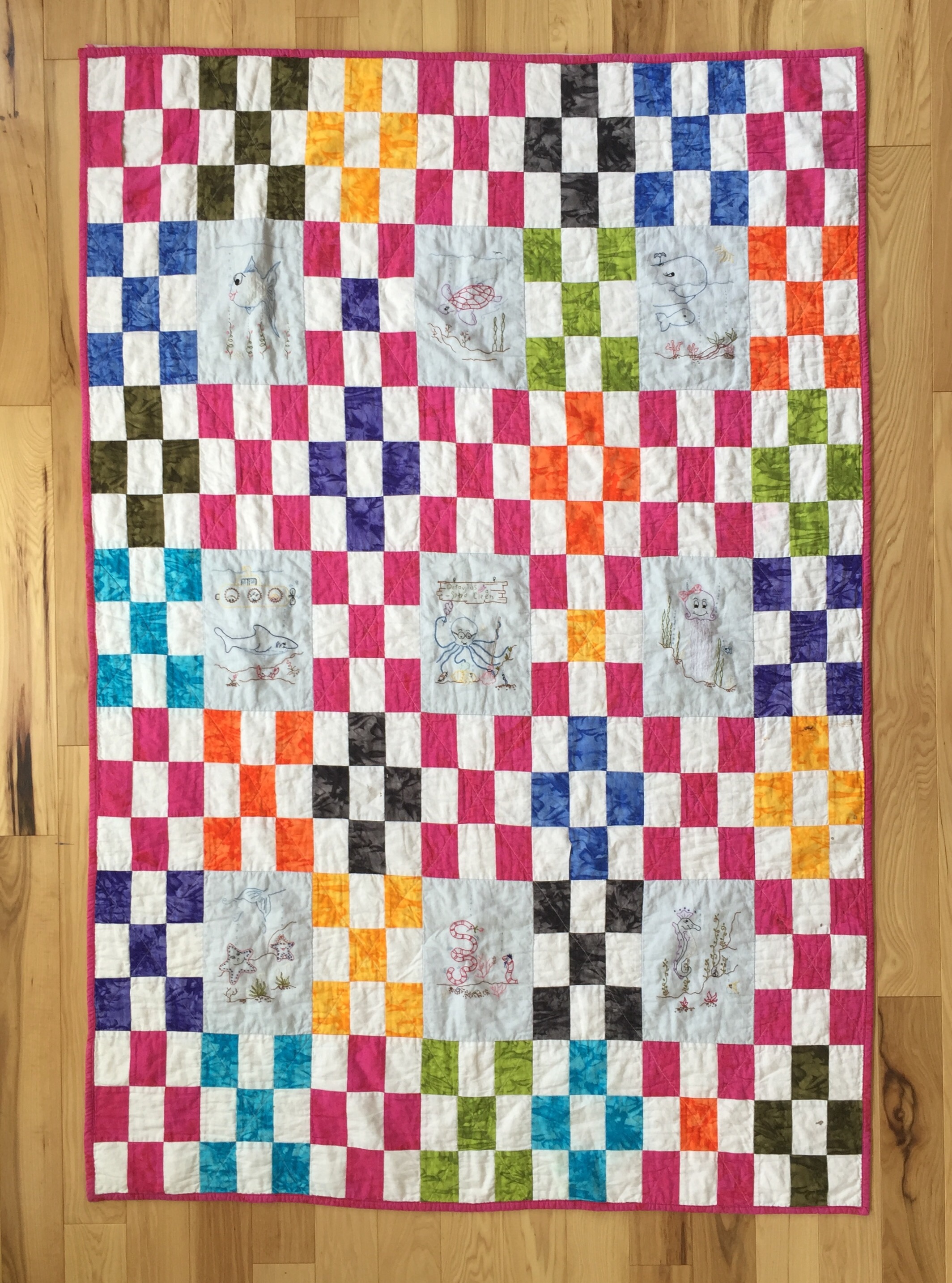
Another interesting option is to make blocks that are not squares. Here is a quilt I made for my daughter.
The embroidery designs didn’t fit nicely into a square block, so I make the blocks 6″x9″ rectangles. (I chose that size deliberately because it was easy to divide by 3.)
When you are designing your own quilt blocks, if the math is too hard, you have the power to change the question.
Don’t you wish you could have done that when you were in school?
Nine Patch Block variations
These tips can be used with a basic nine patch block, but also with any nine patch block variation. Check out these popular variations:
Quilts with nine patch blocks
Step by Step Challenge Quilt
This quilt is just nine patch blocks with nothing else. It shows off a gradient fabric collection.